Early Years Online shop is home to publications and resources which are written or recommended by our Early Years experts to support service providers in the day to day running of their business and providing high quality practice. Use the category tags below to browse the resources.

Need to return or get a refund? Early Years is committed to adhering to all legal regulations with regard to refunds and returns of its publications and resources. Check out our policy here.
It is often said that our staff are our most important asset and even though it is a cliché, it is completely true. Staff are the defining factor which marks great settings out from merely adequate ones. That is why understanding staff support and supervision is so important.
This manual will examine all aspects of staff support and supervision from induction to appraisal with the objective of developing a system which supports the best performance possible in the interests of your setting and the children and families it serves.
The manual covers areas such as Performance Management Systems Understanding of Support and Supervision
Induction of New Employees
Probation Process
Supervision Meetings
Appraisal Meetings
Training and Development
This manual is designed to help settings understand the main employment issues which they are likely to encounter when they employ staff. Staff may be the greatest cost to your organisation but they are undoubtedly also its greatest asset and are the key determining factor between successful and unsuccessful settings. Early Years strongly believes that as well as making sure you fulfill your legal duties, you should also treat your employees in a positive manner which reflects the values of the work that you do. We strongly believe that this in turn will help your setting produce the best possible outcomes for the children and families with which you work.
Content includes information on the following topics:
Staff Terms and Conditions
Pay
Sick Pay
Managing Absence and Sickness
Health and Safety
Working hours and breaks
Leave
Flexible Working
Overtime and Time Off In Lieu (TOIL)
Trade Union Rights
Managing Performance
Disciplinary Procedures
Pensions
Redundancy
One of the most critical roles in governance is to ensure your setting is on a sound financial footing for the short, medium and long term. No matter how big or small your budget is, it is vital that all members of the management committee have a clear understanding of finances and that they exercise appropriate control over income and expenditure.
This manual is designed to help groups understand the main financial considerations they should take into account when managing their settings. Sound financial control will help ensure that your setting is solvent, well run, attractive to funders and sustainable for the long term. An understanding of the importance of financial planning and decision-making will also help settings use their financial resources well for the delivery of the best outcomes for children.
Content includes information on:
Financial control
Setting a budget
Cash flow projections
Reserves
Accounts
Keeping the books
Income
Expenditure
Bank reconciliation
What to do if you encounter problems
Payment of salaries
Fraud
A invaluable tool for the record keeping of children and staff attendance in settings as well as an important place to store emergency contact information; dietary and other health requirements; and insurance details.
A book full of practical play ideas to use at home with small children. Enables parents to be more confident in helping children develop and learn through play as well as to enhance the parent-child bond. A must have guide for all parents
This book outlines what parents should consider when sending their child with special educational needs (SEN) to a setting and also gives guidance to child care professionals on how to cater to the needs of the children in their setting with SEN.
This book is based upon a positive approach to managing children's behavior and deals with a vast array of issues from reluctant eaters to temper tantrums and more. (Polish Version)
This publication gives a step-by-step guide to recruitment, selection, and induction; offers advice on the legalities of being an employer and provides templates of forms required during the recruitment and selection process, such as job descriptions etc.
This useful little publication provides useful phrases for early years settings in the following languages:
Polish
Latvian
Irish
Lithuanian
Portuguese
The publication covers a variety of topics and includes:
Welcome
Parental consent
Areas of play
Useful phrases for discussion
Policies
Meal times
The management team in any early years setting will have to look to the future success of their setting and to work within a strong set of values which place listening to children, ensuring a strong voice for children and those who care for them, participation, community, partnership, excellence and evidence-based innovation at the forefront of what they do. These values will create a framework for settings to provide services consistent with a positive vision of and for children.
Management teams can be more efficient by reviewing the way in which they operate and by developing their own capacity which will equip people with skills and knowledge, identify skills they have, increase confidence and assist people in taking responsibility to plan for the future of their setting. The concept of capacity building in the voluntary and community sector is similar to the concepts of management and organisational development in the commercial sector.
In this book we will look at financial management and planning for sustainability with a range of guides and templates for management teams.
Parent and Toddler Groups often form the first community development activity by young parents who identify the need to develop support systems for themselves and their young children in their local community.
Parent and Toddler Groups can be as formal or informal depending on the needs of parents at a particular point in time. The important thing is that Parent & Toddler Groups meet the needs of children and their families in an enjoyable, inclusive and safe manner.
The aim of this booklet is to help all those involved in managing and running a Parent and Toddler Group to organise their activities in a way that suits them and the children and families they serve.
Contents include:
Room layout
Children and play
Providing for play
Administration and effective management systems
Safety, health and hygiene
Sample forms
This comprehensive publication is devised as a tool to support settings in writing and developing practice policies and procedures. The templates outlined in this publication can be downloaded from a CD contained within the publication. A range of key types of policy templates are contained within this useful guide including:
Accident and Incident Policy
Children with Additional/Special Needs Policy
CCTV Policy
Complaints/Comment Policy
Safeguarding Children/Child Protection Policy
This Manual compliments the Governance Manual 1: Management Policies and Procedures publication.
This resource covers such areas as:
Why self-evaluation is important
Why to get involved in the self-evaluation process
Who should be involved in the self-evaluation process
Using external published standards or indicators to allow comparisons
Evidence to support judgements
Getting the views of others
Differences between development plans and action plans
In The Three Rs of Leadership, Dr. Julie K. Biddle, PhD, redefines the concept of leadership in early childhood education, proposing a model of shared responsibility among school stakeholders. In this revised perspective, leadership is not tied to a single leader but is instead a quality of organizations that can be exerted by anyone. When educators enter into supportive relationships with each other; engage in reciprocal learning with students, parents, and colleagues; and reflect on their practice, they contribute to the evolution of leadership thinking and leadership action.
Drawing on her 30-plus years of working in and with schools, Dr. Biddle explores the three Rs of leadership in the context of developmentally appropriate programs that promote and support meaningful learning. Chapters in this book examine:
Strategies for building and supporting relationships within early education programs
Practices that encourage reciprocal "give-and-take" learning in schools in both formal and informal ways
Guidelines for reflective practice with colleagues and students
Examples drawn from specific curriculum models and early childhood programs illustrate the ways in which The Three Rs of Leadership can positively impact teacher knowledge, student learning, and program effectiveness.
Supporting your workforce through induction, support, supervision and appraisal has a significant role to play within any workforce.
This publication will complement the work of management teams and will provide better information and practical resources which will support those involved in the support, supervision and appraisal process. It provide templates which offer a format for recording details of the induction, support, supervision and appraisal processes, as well as provide tools which can assist management teams review and manage poor performance through ongoing support and supervision meetings.
‘All About Me - Before I Am Born to Three Months’, has been designed in recognition that every baby is unique and they grow and develop at their own pace. It aims to assist in the understanding of key physical and brain development messages in a user friendly way.
The book also illustrates how parents, carers and family members can support these key messages, in reflection of the vital role that they play in the optimal development of their babies.
This is the second book in the All About Me series, and looks at the stages of development from four months to one year. It aims to assist in the understanding of key physical and brain development messages in a user friendly way.
The book also illustrates how parents, carers and family members can support these key messages, in reflection of the vital role that they play in the optimal development of their babies.
We live in a data-driven world. Almost every transaction and interaction you have with organisations involves you sharing personal data, such as your name, address and birth date. You share data online too, every time you visit a website, search for or buy something, use social media or send an email.
Sharing data helps makes life easier, more convenient and connected. As an individual, you have a right to expect your data to be handled properly by organisations because your data belongs to you. As an organisation, you must respect individual rights with regard to personal data and handle data in a way which complies with regulation and law.
The manual is designed for early years settings. It contains practical advice and examples of how to make sure data protection policies and procedures are in keeping with best practice. It contains templates which you can adapt for your needs. In addition, Early Years – the organisation for young children provides training in the GDPR and data management.
This publication edited by Aldo Fortunati and Barbara Pagni, brings together the essays presented at the International Conference on Children and the Revolution of Diversity, held in San Miniato in February 2018.
The table of contents also includes some unpublished essays that Gloria Tognetti developed in recent years on the subject of the mixed-age group and the curriculum, as well as reflections and comments from various friendly voices of San Miniato, representatives of some of the most important organisations within the Bottega di Geppetto’s international network.
Visit will include:
30 minute Teams call prior to visit, to establish baseline
1.5 hour delivery via Teams
Action plan and report
Visit will include:
· 30 minute Teams call prior to visit, to establish baseline
· 5 hour on-site support visit (inclusive of 1 hour feedback)
· Action plan and report
Visit will include:
30 minute Teams call prior to visit, to establish baseline
2.5 hour on-site support visit (inclusive of 1 hour feedback)
Action plan and report
Visit will include:
30 minute Teams call prior to visit, to establish baseline
5 hour on-site support visit (inclusive of 1 hour feedback)
Action plan
Follow-up visit after actions have been put in place
Report
Training will include:
Specific to setting
Date chosen by setting
3 hours delivery on-site or via Teams
Training designed for setting.
Training will include:
Specific to setting
Date chosen by setting
3 hours delivery via Teams
Topic from a pre-set list
Training will include:
Specific to setting
Date chosen by setting
5 hours delivery on-site
Topic from a pre-set list
Training will include:
Specific to setting
Date chosen by setting
3 hours delivery on-site
Topic from a pre-set list
The service design manual for the Eager and Able to Learn Programme.
(Only available to practitioners who have completed EAL).
This double sided workbench is perfect for use as a learning station, creative bench and building table.
H110 x W100 x D100 cm
Member Price: £556.00 - 20% discount
This book is based upon a positive approach to managing children's behavior and deals with a vast array of issues from reluctant eaters to temper tantrums and more. (Polish Version)
This book presents a six-step mediation process adults can used to help young children resolve disputes. More than fifty scenarios of conflict resolution are included.
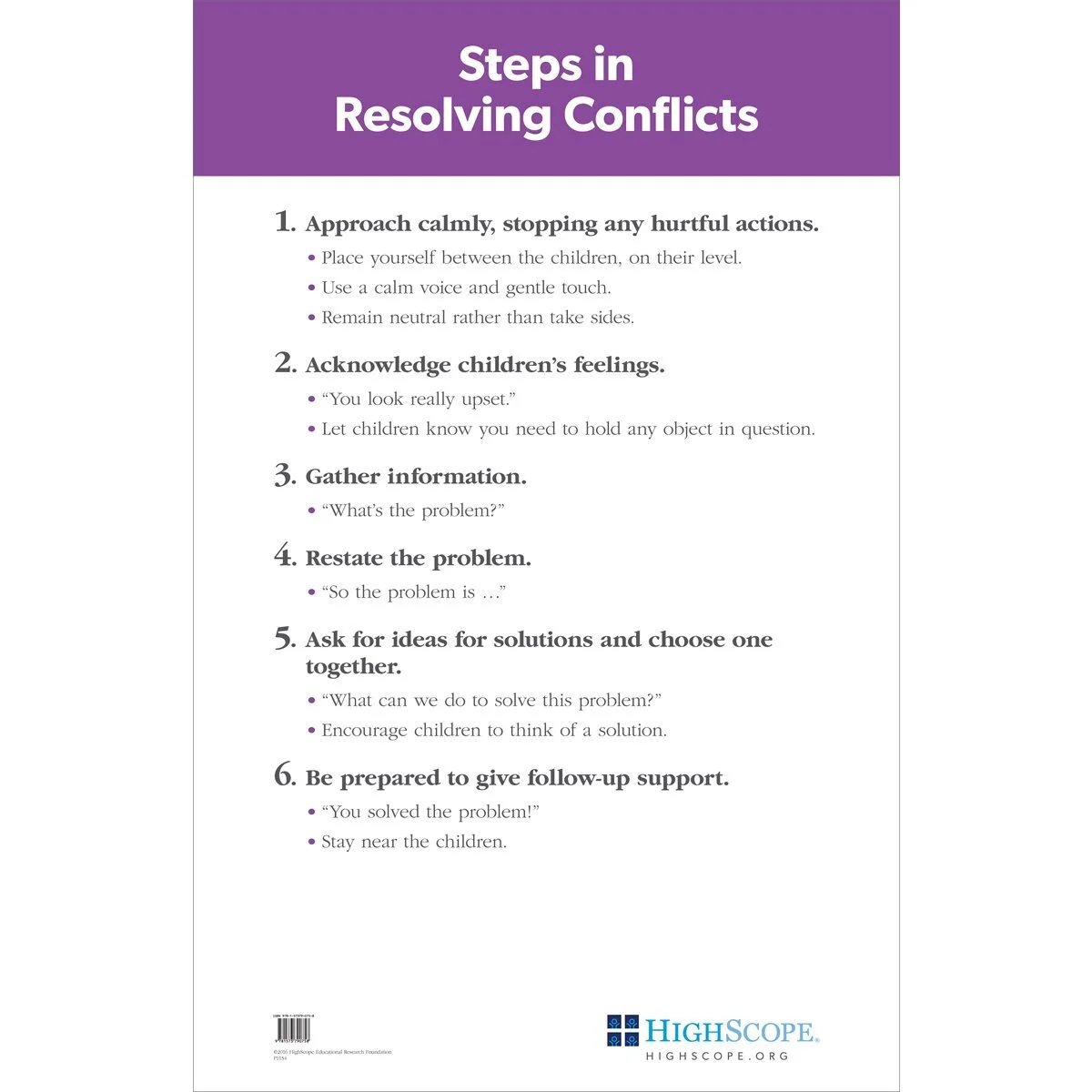
Hang this poster in your classroom to help you remember the six steps to resolving conflicts as you work with children.
This DVD is for adults working in infant and toddler settings and illustrates many strategies caregivers can use to respond sensitively and positively to children's social conflicts. Also covered are ways to keep conflict to a minimum by creating a warm and play-filled environment. The DVD includes both younger and older babies in several High/Scope infant-toddler settings.
This book expands on HighScope's six-step problem-solving approach with a series of 21 scenarios based on real-life parent and teacher interactions with young children. Each chapter explores a typical 'What if...?' question about children's challenging behaviours, which is answered by two sets of illustrated responses: one depicts a 'typical' adult respone to the problem situation; the other details a 'problem-solving' approach to the same question.
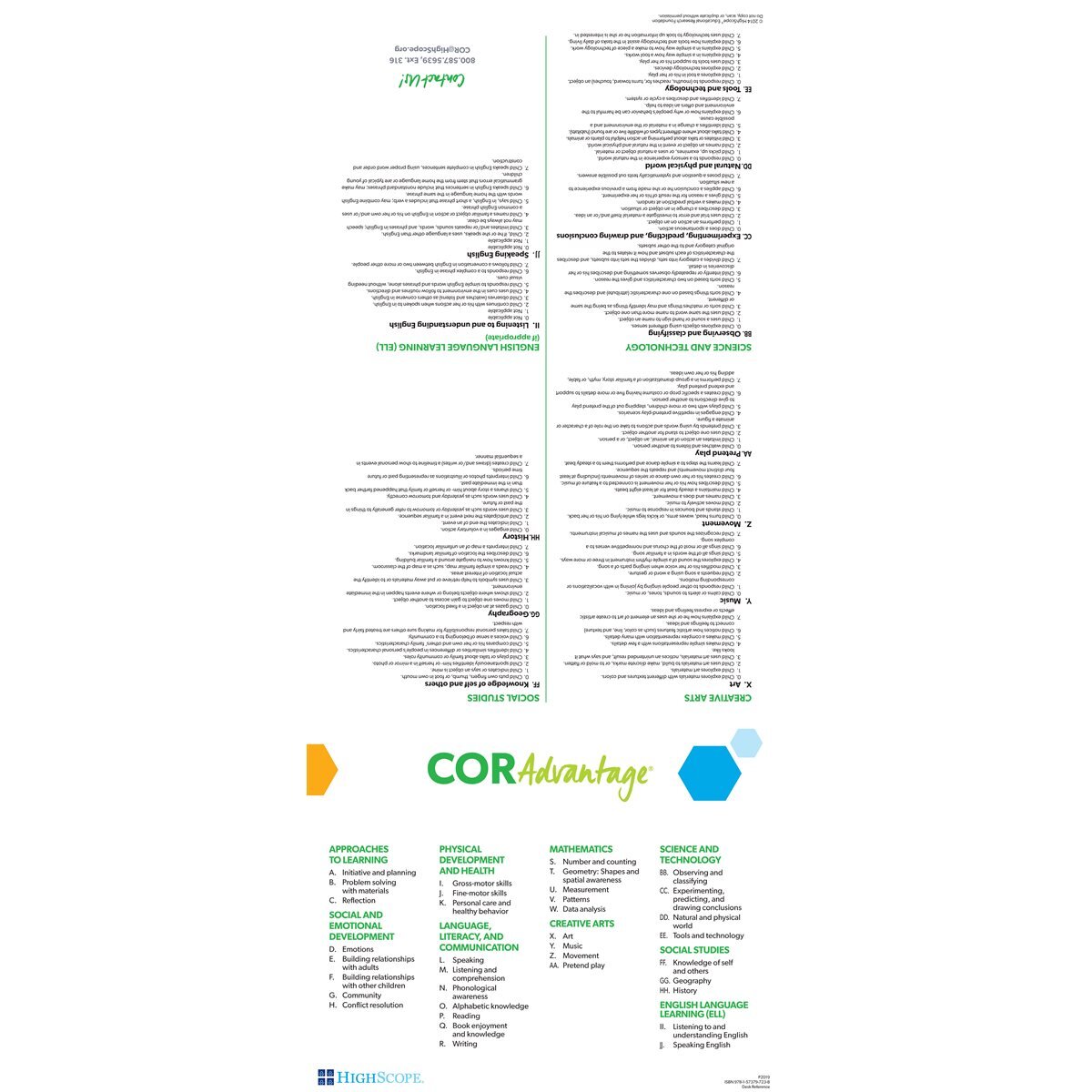
Handy desk-sized laminated guide for quick reference to all the key elements of COR Advantage. Includes 36 COR Advantage items with the eight levels for each item, plus a one-page listing of the COR categories and items.
The instrument provides authentic, reliable assessment of key areas of learning and development for young children from birth through kindergarten. The Scoring Guide enables COR users to score their child anecdotes accurately, using the sample anecdotes and the easy-to-understand explanation given for each COR item and level.
This Scoring Guide is just one of the many useful tools that make up the COR Advantage assessment system.
In all early childhood programs, children have conflicts over space, materials and friendships. Learning how to find solutions that work for everyone is an important educational opportunity for young children.
This three-part DVD program shows unstaged examples of preschoolers who are developing essential communication, empathy, and negotiating skills. The problem-solving process they are learning – with their teachers' guidance and support – fosters social, language, and cognitive abilities they will use throughout their lives. Includes a special section on preventing bullying. The diverse settings shown include two Head Start programs, the HighScope Demonstration Preschool, and a nonpublic school serving children with disabilities.
•Section 1 (21 min.) shows teachers using basic HighScope Curriculum strategies to create an environment that nurtures children's problem solving.
•Section 2 (25 min.) illustrates six steps or strategies that make up HighScope's conflict resolution process for children.
•Section 3 (44 min.) offers strategies teachers can use now to prevent children from developing bullying behavior patterns in later years.
The Anecdotes booklet enables you to create a personal log of each child's actions and abilities, providing the information you need to complete the COR Advantage assessemnt and plan ways to support the child's development.
This booklet explains what COR Advantage is, how it works, and how your child's teacher can use it to support your child and help you do the same at home.
These reproducible forms are on sturdy laminated cards for ease of duplication. The forms allow you to organize and summarize COR Advantage results for each child and for the class as a whole. Both forms include spaces for four reporting periods.
Hang this poster in your classroom to help you remember the six steps to resolving conflicts as you work with children.
This book contains stories of hope and encouragement and of what early
childhood practitioners can do, and achieve in the face of adversity. It shows us
that it is possible to make a real difference in the lives of children and families in
societies affected by conflict. Includes a chapter based on Northern Ireland.
A invaluable tool for the record keeping of children and staff attendance in settings as well as an important place to store emergency contact information; dietary and other health requirements; and insurance details.